Java 面试题 - Arrays and Strings

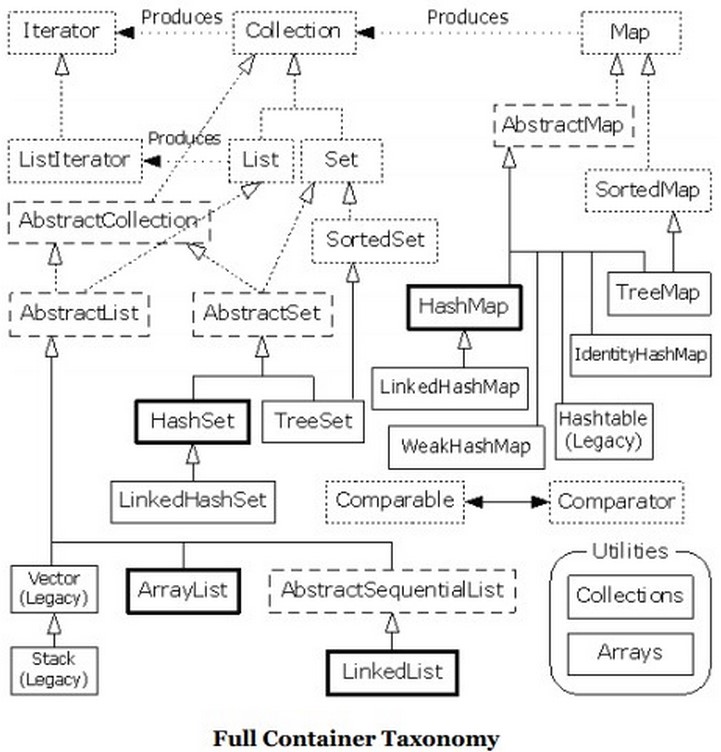
Java容器类库图


HashMap和Hashtable

  • HashMap不是线程安全的,由于非线程安全,效率上可能高于Hashtable;
  • Hastmap是Java 1.2引进的Map interface的一个实现;其中键和值都是对象,可以包含重复值。HashMap允许null key和null value,而hashtable不允许;
  • 为一个HashMap提供外同步。其中一个方法就是利用Collections类的静态的synchronizedMap(),它创建一个线程安全的Map对象,并返回一个封装的对象。这个对象的方法可以让你同步访问潜在的HashMap;
  • HashMap去掉了HashTable的contains方法,但加上了containsValue()和containsKey()方法;
  • HashTable是线程安全的一个Collection,继承自陈旧的Dictionary类;

Set集合

  • 可以实例化的类为:CopyOnWriteArraySet(线程安全,使用CopyOnWriteArrayList为容器),HashSet,LinkedHashSet,TreeSet;
  • TreeSet 和 HashSet 把 set 中的元素作为 Map 中的“键”,从而保持元素的唯一性。
  • 加入在 Set 中存放的是自定义的类实例的时候,这时候要重新定义 hashcode 和 equal 方法,用自己的关键字段来重写,因为当使用 HashSet 时,hashCode() 方法就会得到调用,判断已经存储在集合中的对象的 hashcode 值是否与增加的对象的 hashcode 值一致;如果不一致,直接加进去;如果一致,再进行 equals() 方法的比较,equals() 方法如果返回true,表示对象已经加进去了,就不会再增加新的对象,否则加进去。
  • TreeSet使用元素的自然顺序对元素进行排序,或者根据创建 set 时提供的 Comparator 进行排序,具体取决于使用的构造方法。
  • Set中实现元素互异的各种方法差异很大,大致可以分为三种:使用equals;使用hashCode;使用compareTo。
  • 通常都会选择一个 HashSet,因为它专门对快速查找进行了优化。

ArrayList、LinkedList和Vector

  • ArrayList和Vector是采用数组方式存储数据,此数组元素数大于实际存储的数据以便增加和插入元素,但是插入数据要涉及到数组元素移动等操作,所以索引数据快而插入数据慢;
  • ArrayList,长于随机访问元素,但在中间插入和移除元素时较慢;
  • ArrayList和Vector的访问性能是 O(1); 尽管扩展长度时将花费 O(n) 的时间, 但由于很少发生,通常情况下摊销(amortize)后的性能仍是 O(1);
  • Vector由于使用了synchronized方法,所以性能上比ArrayList要差;
  • Vector缺省情况下自动增长原来一倍的数组长度,而ArrayList是原来的50% (但CareerUp 150这本书则是说Double);
  • LinkedList使用双向链表实现存储,按序号索引数据需要进行向前或向后遍历,但是插入数据时只需要记录本项的前后项即可,所以插入数度较快!
  • LinkedList,较之ArrayList在中间插入和移除元素时代价低,但随机访问方面相对较慢,不过它的特性集较ArrayList更大;
  • ListIterator,更强大的 Iterator 子类型,可以创建一个一开始就指向列表索引为 n 的元素处的 ListIterator。

StringBuffer 和 StringBuilder

《Java编程思想》:
其实,每当把String对象作为方法的参数时,都会复制一份引用,而该引用所指的对象其实一直待在单一的物理位置上,从未动过;
对一个方法而言,参数是为该方法提供信息的,而不是想被该方法改变;
如果知道最终字符串大概有多长,那预先指定StringBuilder的大小可以避免多次重新分配缓冲;
StringBuffer是线程安全的,因此开销较大;

Question: What is the running time of this code?

1
2
3
4
5
public String makeSentence(String[] words) {
StringBuffer sentence = new StringBuffer();
for (String w : words) sentence.append(w);
return sentence.toString();
}
  • Answer: O(n^2), where n is the number of letters in sentence.
  • Here’s why: each time you append a string to sentence, you create a copy of sentence and run through all the letters in sentence to copy them over If you have to iterate through up to n characters each time in the loop.

面试题补充

1、Implement an algorithm to determine if a string has all unique characters What if you can not use additional data structures?

1
2
3
4
5
6
7
8
9
10
11
12
13
14
15
16
17
18
19
20
21
22
23
// first solution:
public static boolean isUniqueChars2(String str) {
boolean[] char_set = new boolean[256];
for (int i = 0; i < str.length(); i++) {
int val = str.charAt(i);
if (char_set[val]) return false;
char_set[val] = true;
}
return true;
}
// second:
public static boolean isUniqueChars(String str) {
int checker = 0;
for (int i = 0; i < str.length(); ++i) {
int val = str.charAt(i) - ‘a’;
if ((checker & (1 << val)) > 0) return false;
checker |= (1 << val);
}
return true;
}
// third:
// Check every char of the string with every other char of the string for duplicate occurrences.
// This will take O(n^2) time and no space.

2、Write code to reverse a C-Style String.

1
2
3
4
5
6
7
8
9
10
11
12
13
14
15
void reverse(char *str) {
char * end = str;
char tmp;
if (str) {
while (*end) {
++end;
}
--end;
while (str < end) {
tmp = *str;
*str++ = *end;
*end-- = tmp;
}
}
}

3、Design an algorithm and write code to remove the duplicate characters in a string without using any additional buffer. NOTE: One or two additional variables are fine, An extra copy of the array is not.

1
2
3
4
5
6
7
8
9
10
11
12
13
14
15
16
17
18
19
20
21
22
23
24
25
26
27
28
29
30
31
32
33
34
35
36
37
38
39
40
41
// first solution:
public static void removeDuplicates(char[] str) {
if (null == str) return;
int len = str.length;
if (len < 2) return;
int tail = 1;
for (int i = 1; i < len; ++i) {
int j;
for (j = 0; j < tail; ++j) {
if (str[i] == str[j]) break;
}
if (j == tail) {
str[tail] = str[i];
++tail;
}
}
str[tail] = 0;
}
// second:
public static void removeDuplicatesEff(char[] str) {
if (str == null) return;
int len = str.length;
if (len < 2) return;
boolean[] hit = new boolean[256];
for (int i = 0; i < 256; ++i) {
hit[i] = false;
}
hit[str[0]] = true;
int tail = 1;
for (int i = 1; i < len; ++i) {
if (!hit[str[i]]) {
str[tail] = str[i];
++tail;
hit[str[i]] = true;
}
}
str[tail] = 0;
}

Test Cases:

  1. abcd;
  2. aaaa;
  3. null;
  4. aaabbb;
  5. abababa;

4、Write a method to decide if two strings are anagrams(回文) or not.

1
2
3
4
5
6
7
8
9
10
11
12
13
14
15
16
17
18
19
20
21
22
23
24
25
26
27
28
29
30
// first solution:
boolean anagram(String s, String t) {
return sort(s) == sort(t);
}
// second
public static boolean anagram(String s, String t) {
if (s.length() != t.length()) return false;
int[] letters = new int[256];
int num_unique_chars = 0;
int num_completed_t = 0;
char[] s_array = s.toCharArray();
for (char c : s_array) { // count number of each char in s.
if (letters[c] == 0) ++num_unique_chars;
++letters[c];
}
for (int i = 0; i < t.length(); ++i) {
int c = (int) t.charAt(i);
if (letters[c] == 0) { // Found more of char c in t than in s.
return false;
}
--letters[c];
if (letters[c] == 0) {
++num_completed_t;
if (num_completed_t == num_unique_chars) { // it’s a match if t has been processed completely
return i == t.length() - 1;
}
}
}
return false;
}

5、Write a method to replace all spaces in a string with ‘%20’ .

1
2
3
4
5
6
7
8
9
10
11
12
13
14
15
16
17
18
19
20
21
public static void ReplaceFun(char[] str, int length) {
int spaceCount = 0, newLength, i = 0;
for (i = 0; i < length; i++) {
if (str[i] == ‘ ‘) {
spaceCount++;
}
}
newLength = length + spaceCount * 2;
str[newLength] = ‘\0’;
for (i = length - 1; i >= 0; i--) {
if (str[i] == ‘ ‘) {
str[newLength - 1] = ‘0’;
str[newLength - 2] = ‘2’;
str[newLength - 3] = ‘%’;
newLength = newLength - 3;
} else {
str[newLength - 1] = str[i];
newLength = newLength - 1;
}
}
}

6、Given an image represented by an NxN matrix, where each pixel in the image is 4 bytes, write a method to rotate the image by 90 degrees Can you do this in place?

1
2
3
4
5
6
7
8
9
10
11
12
13
14
public static void rotate(int[][] matrix, int n) {
for (int layer = 0; layer < n / 2; ++layer) {
int first = layer;
int last = n - 1 - layer;
for(int i = first; i < last; ++i) {
int offset = i - first;
int top = matrix[first][i]; // save top
matrix[first][i] = matrix[last-offset][first]; // left -> top
matrix[last-offset][first] = matrix[last][last - offset]; // bottom -> left
matrix[last][last - offset] = matrix[i][last]; // right -> bottom
matrix[i][last] = top; // right <- saved top; top -> right
}
}
}

7、Assume you have a method isSubstring which checks if one word is a substring of another Given two strings, s1 and s2, write code to check if s2 is a rotation of s1 using only one call to isSubstring (i e , “waterbottle” is a rotation of “erbottlewat”)

1
2
3
4
5
6
7
8
9
10
public static boolean isRotation(String s1, String s2) {
int len = s1.length();
/* check that s1 and s2 are equal length and not empty */
if (len == s2.length() && len > 0) {
/* concatenate s1 and s1 within new buffer */
String s1s1 = s1 + s1;
return isSubstring(s1s1, s2);
}
return false;
}

8、Given a circular linked list, implement an algorithm which returns node at the beginning of the loop

Input: A -> B -> C -> D -> E -> C [the same C as earlier]
Output: C

1
2
3
4
5
6
7
8
9
10
11
12
13
14
15
16
17
18
19
20
21
LinkedListNode FindBeginning(LinkedListNode head) {
LinkedListNode n1 = head;
LinkedListNode n2 = head;
while (n2.next != null) { // Find meeting point
n1 = n1.next;
n2 = n2.next.next;
if (n1 == n2) break;
}
// Error check - there is no meeting point, and therefore no loop
if (n2.next == null) return null;
/* Move n1 to Head. Keep n2 at Meeting Point. Each are k steps from the Loop Start.
* If they move at the same pace, they must meet at Loop Start. */
n1 = head;
while (n1 != n2) {
n1 = n1.next;
n2 = n2.next;
}
return n2; // Now n2 points to the start of the loop.
}

一些补充:
$ javap -c SampleClass # 反编译命令使用示例
《Java编程思想》:
无意识的递归,ArrayList.toString(), public String toString() { return “ InfiniteRecursion address: “ + this + “\n”; }, Object.toString();